
What a Fractional CTO Costs in 2026 (And the Full-Time Comparison)
Most founders meet the fractional CTO idea as a staffing shortcut. The better frame is a budget question: technical leadership is a six-figure line whether you hire for it or not, and the only real choice is whether you buy it deliberately. Engineering was the largest single hiring function at startups in the first half of 2025, taking about 29.7% of all new hires (Carta). Compensation typically consumes over 75% of a startup's operating expenses (Kruze Consulting). And the cost of getting the team wrong shows up in the post-mortems: 23% of failed startups cited "not the right team," behind "no market need" (42%) and "ran out of cash" (29%) (CB Insights, via Inc.).
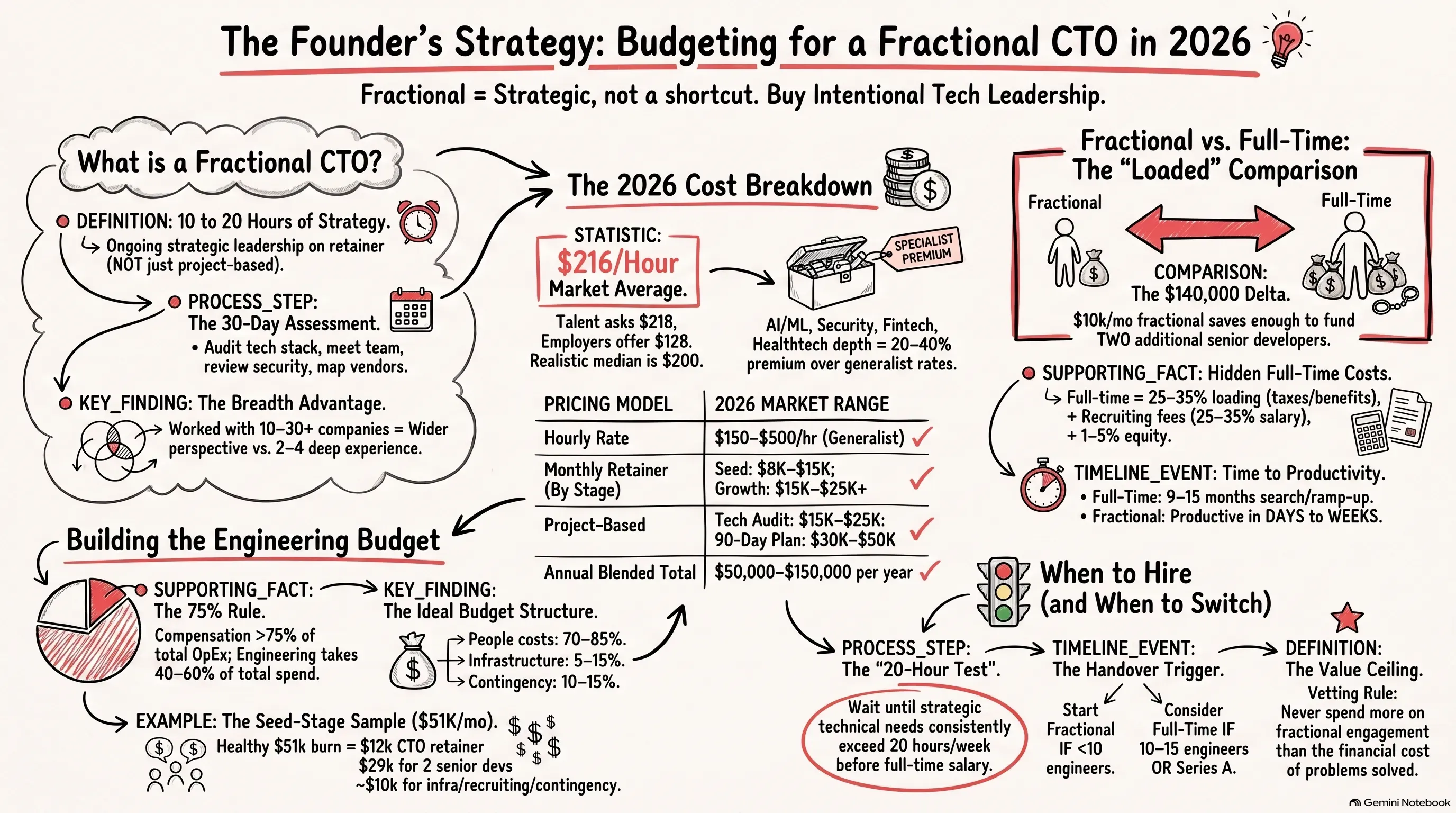
This article gives you four things you can put in a board deck: what a fractional CTO costs in 2026, how a full-time CTO adds up once you load every cost, a line-item engineering budget you can copy, and the triggers that tell you when to switch. Along the way you'll see what good fractional CTO services include, so you can hold any candidate to it.
What is a fractional CTO?
A fractional CTO is a senior technology leader who serves multiple companies at once, providing CTO-level strategy part-time, typically 10 to 20 hours a week (KORE1). The fractional CTO meaning gets muddy because the phrase overlaps with two cheaper things. A consultant comes in for a project, delivers it, and disengages. An advisor gives you 1 to 5 hours a month and usually takes equity. A fractional CTO provides ongoing strategic leadership on a retainer and is paid primarily in cash (PocketCTO Partners).
Engagements typically run six to 18 months, and the first two to four weeks are spent in assessment mode: auditing the stack, meeting every engineer, reviewing security, mapping vendors (KORE1). One breadth claim worth weighing, from the staffing side: a fractional CTO has typically worked with 10 to 30 or more companies, against a full-time CTO's deep experience at two to four (KORE1).
So what does a fractional CTO do that belongs in a budget conversation? The core duties include vendor evaluation, help with cost estimation, and defining your software development team structure (Founder Institute). That is budgeting work, not just leadership work, which is why the part-time CTO model earns a line in your plan rather than a footnote.
What does a fractional CTO cost in 2026?
Start with the only live dataset in the niche. Go Fractional's rolling 90-day benchmark of job posts and candidate profiles puts the average fractional CTO rate at $216/hour, the median at $200/hour, and the 25th to 75th percentile at $160 to $250/hour, which they call a realistic budgeting range for most engagements (Go Fractional). The typical engagement runs about 14 hours a week, roughly 1.8 days, at an estimated $12,000 a month from an $8,900 starting retainer (Go Fractional).
Published fractional CTO rates are all over the place, so here is the reconciliation. These are market-consensus ranges from provider rate guides, 2025–2026, US, not independent measurement:
| Pricing model | Range |
|---|---|
| Hourly | $150–$500/hr; specialists (AI/ML, security, fintech, healthcare) $600–$1,000+ (Truvisory) |
| Day rate | $1,200–$4,000 (Truvisory) |
| Monthly retainer, by intensity | ~$8K–$12K at one day/week, ~$15K at two days, $25K+ at three or more (Truvisory; Kompella) |
| Monthly retainer, by stage | Pre-seed/advisory $3K–$8K; seed $8K–$15K; growth $15K–$25K+ (Truvisory) |
| Project/fixed-scope | $5K–$75K per deliverable; tech-debt audit $15K–$25K, 90-day technology plan $30K–$50K (Truvisory; Kompella; PocketCTO Partners) |
| Annual, all-in | $50,000–$150,000/yr blended (Truvisory) |
For context, Connectd's US rate guidance for fractional CTOs runs $200–$350+/hour with $10,000–$22,000/month retainers, but that reflects the full market spectrum including private equity and enterprise, so early-stage-realistic rates sit lower (Connectd).
Scope moves the number most: retainers cluster at $3,000 to $15,000 a month for most engagements, with intensive ones at $20,000 to $25,000+ (Truvisory; KORE1). Where the person sits matters too. Rates run $275–$350/hour in San Francisco, New York, and Seattle, $200–$275 in second-tier markets like Denver, Austin, and Chicago, and $150–$200 in smaller metros and for international talent (Truvisory). And if you need AI/ML, security, fintech, or healthtech depth, expect 20–40% premiums over generalist rates (Truvisory; Kompella).
One more reason to anchor your budget to retainers rather than hourly headlines: in the same Go Fractional dataset, employers posting fractional CTO jobs offer $128/hour on average while talent asks $218/hour (Go Fractional). A $90 spread means any single hourly figure you read is somebody's opening position, not a market price. How much does a fractional CTO cost? Whatever the retainer says, and the stage bands above are your negotiating range. The same logic applies to CTO as a service offerings: judge them on the monthly retainer, not the sticker hourly rate.
Fractional CTO vs full-time CTO: the full budget comparison
Most comparison articles stop at salary. Salary is where the full-time column starts, not where it ends. Here is the side-by-side with every cost loaded.
| Cost line | Full-time CTO | Fractional CTO |
|---|---|---|
| Cash salary | $167,000 avg / $166,000 median at US startups in 2026; Seed $155K, Series A $196K (Kruze); BLS median for computer and information systems managers $175,140 (BLS) | Retainer, annualized: $60K–$180K/yr (KORE1) |
| Employment loading | +25–35% above base (payroll taxes ~10%, benefits ~20%); equipment one-time $2,500–$3,000 (Kruze) | None, outside the retainer |
| Recruiting | 25–35% of first-year comp (recruiting-firm norm) (Bolster) | Usually none |
| Equity | 2–5% at seed, 1–3% at Series A (provider-published ranges) (PocketCTO Partners); 1–2% at a $10M valuation is a $100K–$200K commitment (Kompella) | Usually none; 0.25%–2% where granted, paired with reduced cash |
| Time to productivity | 9–15 months search plus ramp, per provider estimates (Kompella) | Days to weeks (KORE1) |
| First-year all-in | $375K–$555K (Pangea), $350K–$550K+ (Kompella), $300K–$500K+ (Truvisory), ~$400K median (Go Fractional) | $60K–$180K |
Sources for the totals row: Pangea, Kompella, Truvisory, Go Fractional. These are provider-built cost models, not independent measurement, though the salary and overhead components check out against Kruze's payroll data and the BLS.
Two nuances on the time-to-fill line, because they get flattened in most comparisons. SHRM's 2025 benchmarking puts median time-to-fill at roughly a month and a half, but that measures requisition to offer acceptance, not search lead time or ramp-up (SHRM). Kompella's 9 to 15 month figure for a full-time CTO includes both. Also worth knowing: non-founding CTOs earn about $50K–$60K more than founding CTOs, $213,000 versus $139,000 overall in Kruze's 2024 dataset (Kruze), and if you're recruiting rather than promoting, you're paying the higher number.
Now the bridge. A $15,000/month fractional CTO at two days a week costs $180,000 a year, roughly 40–50% of the full-time equivalent (Kompella). Or take the sharper version: a $10,000/month fractional engagement against $260K+ of first-year full-time cash saves roughly $140,000 in year one, enough to fund two senior developers (Continuum). That claim holds up against independent wage data, since the BLS median for software developers is $135,980 (BLS). The gap between your leadership options is your first two hires.
How a fractional CTO builds your engineering budget
This is the part nobody else writes: putting the fractional CTO inside the startup engineering budget instead of next to it. A fractional CTO who has done this across dozens of companies brings the structure, the multipliers, and the honesty about what salaries really cost.
The structure of an engineering team budget, from TeamCalc's guide for tech companies: people costs run 70–85% of the engineering budget, infrastructure 5–15% (TeamCalc). Salaries need a US on-cost multiplier of 1.30–1.55x base. Budget recruiting at 10–20% of annual new-hire salary cost, carry a 10–15% contingency line, and expect 10–15% annual attrition (TeamCalc). Kruze's version of the multiplier from real payroll records: plan total compensation costs at 25–35% above base salary (Kruze). For salary anchors, the BLS median for software developers is $135,980 and QA analysts sit at $104,300 (BLS).
Runway discipline comes with rules. Kruze's guidance: start fundraising when about 10 months of runway remain, and link any escalation in expenses to the achievement of specific milestones (Kruze). CB Insights' analysis of 431 VC-backed shutdowns since 2023 found a median of 22 months from last fundraise to death, with 70% citing "ran out of capital" as the final cause (CB Insights). For context on how big this line is: Pilot's 2025 Startup Benchmark Report puts engineering at 40–60% of total spend for the average venture-backed company, and a First Round Capital survey found 65–75% of engineering budgets go to developer salaries and contracts (Pilot and First Round, via Geminate).
Here is a worked example, with every assumption labeled as one. Seed startup, $1.2M raise, targeting 18 months of runway. That gives a total budget of roughly $67K/month (assumption, arithmetic, not a benchmark), of which this plan carves out about $51K/month for engineering and leaves the rest for everything else a company spends money on. Calibrate the scale first: Carta's data shows the median seed-stage team is now four employees (Carta), so this is a small-team budget, which is the norm now.
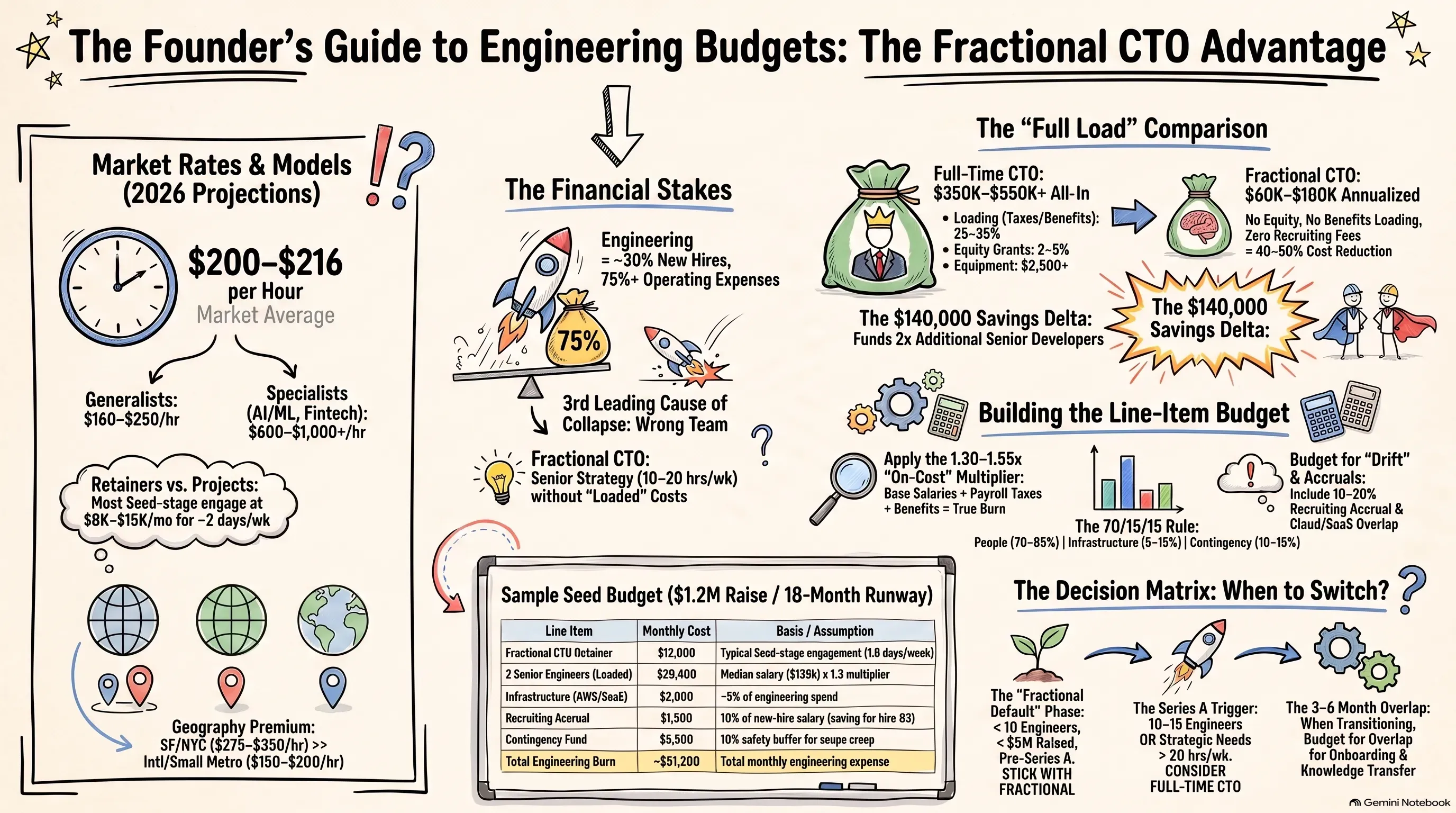
| Line item | Monthly | Basis |
|---|---|---|
| Fractional CTO retainer | $12,000 | Seed band $8K–$15K/mo (Truvisory); $12K/mo is Go Fractional's typical-engagement estimate (Go Fractional) |
| 2 senior engineers, fully loaded | $29,400 | BLS developer median $135,980 × 2 ÷ 12 × 1.3 on-cost (BLS; TeamCalc) |
| Infrastructure | $2,800 | ~5% of the engineering budget, at the low end of the 5–15% band, small team (assumption) |
| Recruiting accrual | $1,500 | ~10% of new-hire salary cost, accruing toward the third hire (assumption) |
| Contingency | $5,500 | ~10% of the engineering budget (TeamCalc) |
| Total engineering budget | ~$51,200 | Arithmetic on the lines above |
Be honest about what this table says: the fractional CTO fee is about a fifth of monthly engineering burn in this setup, and roughly 18% of the company's total $67K monthly burn. If it were just a salary, that would be a terrible deal. The justification has to come from the other lines, which is the next section.
The frameworks behind this kind of plan come from the providers who run these engagements. Kompella's four-step approach: define your needs and the cost of delayed decisions, which sets a "value ceiling" where you shouldn't spend more than the problems are costing you; pick the right engagement level, 1–2 days a week for most seed-to-Series A companies; plan a 6–12 month engagement; and factor the full picture including recruiting fees, equity, benefits, the productivity loss of a bad hire, and the opportunity cost of delayed technical decisions (Kompella). PocketCTO's first screening question for founders is blunt: "What's your monthly burn rate? (Can you afford $200k+ salary?)" (PocketCTO Partners). Algocentric runs engagements on a 90-day cadence: month one, audit and roadmap; month two, execute and mentor; month three, scale and handover (Algocentric).
The other budget lines a fractional CTO fixes
The retainer pays for itself in lines it touches, not the leadership line itself.
Hiring is the biggest. A scoped example from HyperNest Labs' pricing: "Build hiring process and make first 3 hires: $30K" (HyperNest Labs). For scale, the recruiting-firm norm is 25–35% of first-year compensation for retained executive search (Bolster), and engineering carries real hiring weight: it took about 29.7% of all startup new hires in H1 2025, tied with product for the highest average new-hire salary at $189,000 (Carta).
Tooling drifts. KORE1's illustration: the average mid-market company runs 40 to 80 SaaS tools, and half of them overlap (KORE1). Cloud drifts worse, in their telling: AWS bills that started at $3,000 a month are suddenly $18,000 and nobody can explain why (KORE1). Both are provider illustrations, not benchmarks, but any founder who has read their own AWS bill recognizes the shape.
Then there's the build/buy/offshore mix, where vendor evaluation and cost/time estimation are core fractional CTO tasks (Founder Institute). For directional context only, and from 2023 data so treat it as a rough guide: US developers run $50–$200/hour against India at $30–$100 and Ukraine at $40–$150 (TechNext).
The through-line is the CTO-plus-CFO link. As KORE1 puts it, technology decisions and financial decisions are connected, and the budget constrains the technology decisions (KORE1). That's the actual job.
How much equity should a fractional CTO get?
Usually none. Cash-first is the norm across the provider guides: most fractional CTOs take no equity at all, and where it is granted, 0.25% to 2%, typically paired with a reduced cash rate and reserved for long engagements (Truvisory; PocketCTO Partners; Continuum).
The red flag line is clear: equity above about 3% for a non-cofounder, or an equity-only deal with no cash, often signals misaligned expectations or an operator who can't command market cash rates (Truvisory).
For contrast, a full-time CTO runs 2–5% at seed (first 10 employees), 1–3% at Series A, and 0.5–1.5% at Series B+, per provider-published ranges that aren't independently verified (PocketCTO Partners). Even early employees take real chunks: Kruze, citing Carta data on 8,000+ initial grants, puts the median first-hire grant at 1.49%, falling to 0.18% by hire ten, on standard four-year vesting with a one-year cliff (Kruze).
Founder sentiment on this is fairly settled. The recurring advice in founder discussions, including on r/ycombinator: if you're not looking for a technical co-founder, pay cash rather than equity (Reddit). Fractional CTO equity should be a rare, deliberate exception, not the default deal shape.
When to hire a fractional CTO and when to go full-time
For most startups a fractional CTO is the default first move, not the compromise. Carta's data shows the median seed-stage team is now four employees, and average Series B headcount fell from 53 to 45 (Carta). Supply has caught up with demand: professionals describing themselves as "fractional" on LinkedIn grew from a couple thousand in 2022 to over 144,000 by late 2024 (Vendux, citing Axios).
The decision rules, from PocketCTO's stage matrix, with the thresholds worth memorizing:
- Start fractional if the engineering team is under 10 people and funding is under $5M (PocketCTO Partners); another provider puts it as under $2M ARR (Continuum).
- Consider full-time at 10–15 engineers, or from Series A on (PocketCTO Partners). Truvisory puts the threshold at 8–12 engineers (Truvisory).
- Full-time CTO plus VP Engineering at 15+ engineers and Series B+ (PocketCTO Partners).
- Outgrown fractional entirely when technology is the core product with 50+ engineers, or at IPO-level fundraising where investors want a named, full-time CTO on the leadership page (KORE1).
The 20-hours test cuts through most of it: better to wait until strategic technical needs consistently exceed 20 hours a week before hiring full-time, because otherwise you're burning cash on an executive salary before product-market fit (PocketCTO Partners).
When the switch comes, budget it as an event, not a scramble. Most startups hire their first full-time CTO between Series A and Series B, typically at 10+ engineers and $5M+ ARR (PocketCTO Partners), and many fractional engagements end with the fractional CTO helping hire, onboard, and transition to their full-time replacement (KORE1). Plan on a 3–6 month overlap where the fractional CTO works alongside the new hire (PocketCTO Partners).
One caution while you research: the viral claim that "35% of all US companies will have a fractional executive by 2025" has no traceable original source. Vendux's more conservative projection is 15–20% of US SMBs using at least one fractional executive by 2027 (Vendux).
How to hire a fractional CTO (and budget the engagement)
The process that makes the fee pay for itself is short. Define scope and hours per week, interview 3–5 candidates, start with a trial engagement, usually a 90-day audit or assessment, then convert to a retainer if the fit is good (PocketCTO Partners). Onboarding takes 2–4 weeks, so expect the first month to be assessment, not output (PocketCTO Partners).
Contract terms are where you protect the budget. Standard arrangements are month-to-month or quarterly with about 30 days' notice; anyone requiring a year-long commitment upfront is optimizing for their revenue stability, not your flexibility (Kompella). Plan a 6–12 month engagement, and know what each pricing model buys: a retainer buys availability, ongoing access to senior judgment at a set commitment of hours, while fixed-scope pricing buys a deliverable (Truvisory). If you go through an agency rather than an independent, expect 3–6 month minimums with $10K–$25K/month commitments (HyperNest Labs).
Budget the hidden costs before they're a surprise: overage fees, travel, tool and software costs, scope creep, transition costs, and account-manager overhead (HyperNest Labs).
Three vetting questions that do real work:
- "What's your monthly burn rate?" PocketCTO's first screening question, and the one that tells you whether a candidate thinks in budgets or in roadmaps (PocketCTO Partners).
- "What's the value ceiling here?" The Kompella test: you shouldn't spend more on the engagement than the problems are costing you. A candidate who can't size your problems can't size their own fee (Kompella).
- "What do your first 30 days look like?" A good answer includes assessment mode: stack audit, meeting every engineer, security review, vendor mapping (KORE1).
Scope the deliverables as budget items, the way you'd scope any capex. A hiring process plus the first three hires prices at $30K (HyperNest Labs); a tech-debt audit at $15K–$25K; a 90-day technology plan at $30K–$50K (Truvisory). When the fee and the deliverable are the same line item, the engagement gets easy to defend at a board meeting.
FAQ
How much does a fractional CTO cost in 2026?
The realistic hourly band is $160–$250, per Go Fractional's rolling 90-day benchmark, which averages $216/hour (Go Fractional). Monthly retainers cluster at $3,000–$15,000 for most engagements, with seed-stage at $8K–$15K (Truvisory). Blended annual spend runs $50,000–$150,000 (Truvisory). If you're comparing against a fractional CTO salary, the annual figure is the honest one.
What does a fractional CTO actually do for a startup?
The first two to four weeks are assessment: tech-stack audit, meeting every engineer, security review, vendor mapping (KORE1). After that, the budget-relevant duties: vendor evaluation, cost estimation, and defining your software development team structure (Founder Institute).
Fractional CTO vs full-time CTO: which does my startup need?
Under 10 engineers and under $5M raised, start fractional; at 10–15 engineers or Series A+, consider full-time (PocketCTO Partners). Truvisory's corroborating threshold is 8–12 engineers (Truvisory). On cost: fractional runs $60K–$180K a year against $250K–$400K+ fully loaded for full-time (KORE1).
How much equity should a fractional CTO get?
Most take none. Where granted, 0.25%–2%, usually paired with reduced cash (Truvisory). Anything above about 3% for a non-cofounder, or an equity-only deal, is a red flag (Truvisory).
When should a startup hire a full-time CTO instead?
When strategic technical needs consistently exceed 20 hours a week (PocketCTO Partners). Most first full-time CTO hires happen between Series A and B, typically at 10+ engineers and $5M+ ARR, and the transition usually involves a 3–6 month overlap with the fractional CTO (PocketCTO Partners).
How does a fractional CTO help plan engineering hiring and burn rate?
They build the line-item budget: people costs at 70–85% of engineering spend, salaries multiplied by a 1.30–1.55x on-cost, recruiting at 10–20% of new-hire salary cost, plus contingency (TeamCalc). They also bring the runway rules: start raising at about 10 months of runway left, and link expense escalation to milestones (Kruze).
The math, in three lines
Senior technical leadership bought fractionally costs 40–50% of a full-time CTO: $180K a year at two days a week against a loaded $400K median (Kompella; Go Fractional). The roughly $140K delta funds two senior developers at the BLS median of $135,980 (Continuum; BLS). And the fee belongs in the engineering budget as its own line item, with a job to do and a value ceiling it shouldn't exceed (Kompella).
Copy the sample budget table above, swap in your own raise number and runway target, and you have the first board-ready engineering budget most seed-stage companies ever produce. If a fractional CTO candidate can't defend their retainer inside that table, that's your answer.