
The demo was clean. You shipped the feature. Then a customer was told something untrue, and now you're figuring out what to do about it. This isn't a theoretical problem. It's Tuesday afternoon, and hallucinations just became your most urgent reliability problem.
A 2026 lifecycle survey by Naveen Lamba, Sanju Tiwari, and Manas Gaur establishes that AI hallucination risk is not a prompt bug you can patch with better instructions. It's a reliability property distributed across the entire model lifecycle, meaning the data, the training, and the inference. The survey screened 157 papers down to 30 that met strict lifecycle criteria, then coded ten causes (C.D.1 through C.I.4) and mapped mitigation and prevention techniques with measured outcomes.
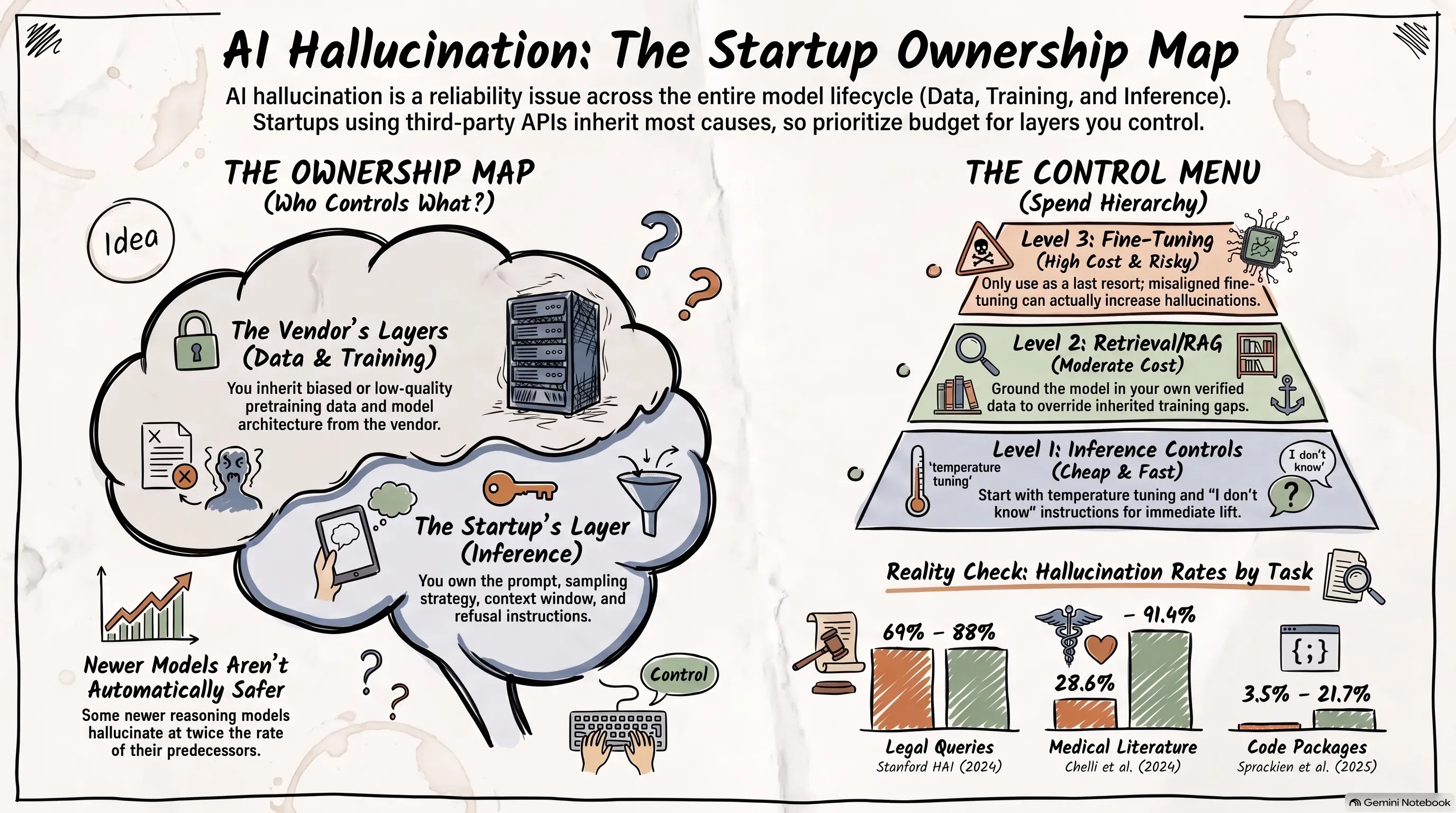
Here's the part that matters if you're a founder: if you consume models through an API, prevention is largely unavailable to you. Prevention in the survey's framework means acting on pretraining data and foundational training, and someone else already made those calls on your behalf. You inherited the result. Your actual levers are detection, mitigation, and the inference layer. Budget accordingly, and stop funding the layers you don't own.
This article tells you where in your stack hallucination risk is produced, which layers you control, and what to spend on first. It's not another "what is AI hallucination" explainer. It's a decision framework built from a peer-reviewed survey that names the causes and measures the controls, so you can sequence spending from cheapest to most expensive.
What the 2026 Lifecycle Survey Actually Did
The survey team searched IEEE Xplore, ACM Digital Library, arXiv, and Google Scholar for work published between 2020 and 2025, and came back with 157 candidate articles. A title and abstract screen cut that to 112. Duplicates, language constraints, and unavailable texts brought the count to 42. A full-text read against the lifecycle criteria left 30 papers. The final corpus was "intended to represent a focused lifecycle-oriented synthesis of methodologically relevant hallucination research rather than an exhaustive catalog".
The framework is a grid: three lifecycle stages (data, training, inference) crossed with four phases (cause, detection, mitigation, prevention), plus a dedicated dimension for benchmarking. That yields 13 aspects in total. Prior surveys covered at most 6 of them; this one covers all 13. The ten coded causes run C.D.1–C.D.3 for data-related issues, C.T.1–C.T.3 for training, and C.I.1–C.I.4 for inference.
The authors name two limitations themselves. Sorting studies that touch multiple lifecycle stages takes some interpretive judgment, and a focused corpus may limit coverage of emerging techniques in a fast-moving field. Translation: this is methodologically solid work with peer-reviewed scope and acknowledged constraints, not another vendor blog post claiming "5 ways to prevent hallucinations."
The Three Places AI Hallucination Is Born—and Which Ones You Own
What causes AI hallucinations? The survey codes ten causes and sorts them across three stages: data, training, and inference. The paper names every one of them. The part it can't answer for you is who controls each layer, and that's the question that decides where your budget goes.
Data Layer (C.D.1–C.D.3)
The survey codes three causes at this stage:
C.D.1 Biased Training Data: "Hallucinations can be common when the social or topical bias in the data is incorporated within the LLM".
C.D.2 Inadequate or Low-Quality Data: "When LLMs are trained on low-quality or unattributed information, they tend to produce contextless or attributionless outputs".
C.D.3 Ambiguous or Conflicting Data: "Ambiguities of training corpora, e.g. conflicting statements, or of context vague information, may lead to fabricated explanations in LLMs".
Ownership verdict: if you're consuming a model through an API, the pretraining data was chosen by OpenAI, Anthropic, Google, or Meta. You did not curate it. You cannot fix C.D.1–C.D.3 at the source. What you can do is retrieval-augmented generation at inference time, where you supply grounded, domain-specific data to override or supplement what the base model learned. That's mitigation, not prevention.
Training Layer (C.T.1–C.T.3)
The training stage gets three causes of its own:
C.T.1 Overfitting and Memorization: "When a model memorizes certain training examples rather than educating generalizable trends, this is referred to as overfitting". When models overfit to the wrong facts or memorize incorrect associations, they reproduce those errors at inference.
C.T.2 Insufficient or Misaligned Fine-Tuning: "Inappropriate fine-tuning can in itself cause, or worsen, hallucinations". This is the survey's own warning: fine-tuning on small or misaligned data is a listed cause of hallucination, not a cure.
C.T.3 Architectural Biases: "Some architectural designs and optimization goals may inadvertently concentrate on facts instead of fluency, which makes the models more susceptible to hallucinations". Attention mechanisms can favor fluent but inaccurate outputs.
Ownership verdict: if you're calling an API, the base model architecture and core training are done. You inherited C.T.3 with the model you chose (GPT-4, Claude, Gemini) and you can't change it. Fine-tuning is available through some providers but expensive (Very High cost per the survey) and introduces new hallucination risk if your training set is small or misaligned. For most startups, the training layer is mostly not yours.
Inference Layer (C.I.1–C.I.4)
The inference stage carries four:
C.I.1 Input Conflicts: "Inconsistent or ambiguous prompts generally give inconsistent or unstable outputs".
C.I.2 Contextual Misalignment: "When contextual information is not correctly integrated or retained it may result in hallucinations". Overconfidence and decoding errors fall here.
C.I.3 Extrapolation Beyond Training Data: "LLMs have a high confidence while giving inaccurate responses to inputs that do not belong to the distribution that they trained on". Confident fabrication on out-of-distribution queries.
C.I.4 Sampling Optimization and Decoding Errors: "Hallucinations can be increased by inefficient decoding or sampling methods including greedy search, beam search, low-temperature sampling among others".
Ownership verdict: this is yours. You control the prompt (C.I.1), the system instructions, the temperature and sampling strategy (C.I.4), the context window and retrieval strategy (C.I.2), and whether you let the model extrapolate or require it to abstain when uncertain (C.I.3). These are inference-time configurations: hours to days of engineering, fully reversible, often free beyond API cost. Start here.
Ownership Map
Data layer: theirs. The vendor's pretraining choices, made long before you were a customer. Your counter is RAG/retrieval at inference.
Training layer: mostly theirs. The base architecture and core training came with the model you picked. Fine-tuning is available, but it's expensive and risky.
Inference layer: yours. Prompts, temperature, sampling, refusal paths, structured output. Cheapest to change and fully reversible, which is why you iterate fastest here.
The Two Expensive Wrong Moves (and Why the Survey's Causes Reveal Them)
Someone on your team has already proposed one of these. The survey's lifecycle framing is the quickest way to see why each move is wrong, and what it will cost you.
Wrong Move #1: "We'll Fix It With Better Prompts"
Prompt engineering is an inference-layer control. It addresses C.I.1 (input conflicts) and improves outcomes when the hallucination originates at inference. The survey's Table 4 shows Prompt Engineering hitting AUC 0.927 and ACC 0.868 on the Concept-7 dataset at Low computational cost. That's real lift, but only for inference-layer causes.
The problem: the survey establishes that causes also live upstream, in data (C.D.1–C.D.3: biased, low-quality, conflicting training data) and in training (C.T.1–C.T.3: overfitting, misaligned fine-tuning, architectural biases). If the fabrication was baked in during pretraining, say the model memorized a false association (C.T.1) or was trained on a corpus with conflicting information (C.D.3), no prompt will undo it. You're iterating on a lever that doesn't reach the defect.
The survey flags Prompt Engineering's own limitation too: "Sensitive to prompt style and model family". You can spend weeks tuning prompts and chase a 10-point accuracy gain, but if the hallucination originates three stages upstream, you're optimizing the wrong layer. Prompt iteration without lifecycle awareness is vibe coding: treating symptoms while the disease lives elsewhere.
The cost: weeks of engineering time on prompt iteration, your eng lead context-switching into every prompt review, morale damage when the rate doesn't drop meaningfully. Meanwhile, the cheaper inference-layer controls (temperature, abstention instructions, structured output) and the retrieval/grounding checks that reach further up the lifecycle sit untouched.
Wrong Move #2: "Let's Fine-Tune It On Our Data"
Fine-tuning can work. The survey's Table 4 shows Fine-Tuning (addressing C.T.2) improving truthfulness from 50.18 to 64.14 and cutting toxicity from 24.6% to 0.01% on the TruthfulQA/MMLU/GSM8K benchmarks. Done well, with large, high-quality, domain-specific training data and proper alignment, it prevents hallucinations.
Here's the catch: the survey lists "Insufficient or Misaligned Fine-Tuning" (C.T.2) as a cause of hallucination, not just a cure. The paper says it outright: "Inappropriate fine-tuning can in itself cause, or worsen, hallucinations". Well-aligned fine-tuning on high-quality data prevents; small, misaligned, or low-quality fine-tuning causes.
Most startups proposing this don't have a pristine, large-scale training corpus. They have a few hundred examples, a CSV of customer queries, or a scraped dataset that hasn't been deduplicated or fact-checked. Fine-tuning on that is rolling the dice: you might reduce hallucinations in one area and introduce them in another.
The survey's cost category for Fine-Tuning is "Very High (full training)", and its limitations include "Expensive; language bias; benchmark limits".
What it actually costs: months of engineering time curating training data, standing up fine-tuning infrastructure, running experiments, evaluating outcomes. Thousands to tens of thousands of dollars in compute, depending on provider and model size. Iteration is slow too, days to weeks per experiment versus minutes for a prompt or temperature change. And if the training set is small or misaligned, you've introduced new hallucination risk (C.T.2) instead of reducing it.
So when does fine-tuning make sense? When you have a large corpus, think thousands to tens of thousands of examples, that's clean and domain-specific. When you've already exhausted the inference-layer and retrieval-layer controls. And when the improvement on your in-house eval set is big enough to justify the cost and the iteration drag. Not as a first move.
The Control Menu, Ordered by What It Costs You
Below are the survey's mitigation and prevention techniques, ordered from cheapest and most reversible to expensive and irreversible. They're grouped by layer, because the layer tells you who owns the knob and how fast you can turn it.
Inference-Layer Controls (Yours, Cheap, Start Here)
Confidence Calibration (C.I.2, C.I.4): ECE reduction from 2.54 to 1.14 on SNLI/MNLI/QQP/SWAG benchmarks, Low cost (post-hoc scaling). In practice this means temperature tuning, abstention instructions ("say 'I don't know' if uncertain"), and confidence thresholds. OpenAI research from September 2025 argues that language models hallucinate because standard training rewards guessing over acknowledging uncertainty, so fix that in your prompts and your eval scoring.
Intervention (C.I.1, C.I.2): TruthfulQA +32.6 pts, Vicuna +22.5 pts, Low cost (activation control). Limitation: truthfulness versus helpfulness trade-off. In your stack this becomes activation steering, refusal paths, and forcing the model to ground its answers in the context you provided. A model that refuses more scores worse on "helpfulness" for ambiguous queries. That's still better than fabricating.
Controlled Decoding (C.I.3, C.I.4): FactKB +14.3%, EM up to 2.9×, Low–Moderate cost (decoding control). The techniques here go by names like DoLa (Decoding by Contrasting Layers), nucleus sampling, and temperature scaling. Most API providers let you set temperature, top-p, and frequency penalty. Run factual tasks at 0.3–0.5 and creative tasks at 0.7–1.0, then test both settings on your eval set.
Self-Consistency Decoding (C.I.2): +17.9% reasoning accuracy on GSM8K, Moderate cost (multi-sampling). Limitation: slow, and it generates inconsistent paths. One refinement worth knowing: RASC (Reasoning Aware Self Consistency) cut sample usage by roughly 70% while maintaining accuracy. The plain version of this control is to generate several answers and pick the most common one. It costs more tokens but catches inconsistencies. Reserve it for high-stakes queries.
Prompt Engineering (C.I.1): AUC 0.927, ACC 0.868, Low cost (prompt design). This is "Wrong Move #1" territory. Useful, but insufficient on its own, so combine it with the other inference-layer controls.
Start here. These controls cost hours to days of engineering, they're fully reversible, and you can test the outcome on your eval set within minutes of making a change. The only real spend is engineering time; no compute or infrastructure outlay beyond normal API usage.
Data/Retrieval Controls (Yours, Moderate Cost, Second Priority)
RAG (Retrieval-Augmented Generation, C.D.1, C.D.3): NQ EM +10 pts, TriviaQA EM 56.8, FEVER 89.5%, High cost (retrieval + training). Limitations: retriever dependency, external knowledge bias. The mechanism is to pull domain-specific, up-to-date, verified data into the context window at inference. You need a retrieval index (a vector DB like Pinecone, Weaviate, or pgvector), an embedding model, and prompt engineering that grounds the model in the retrieved chunks. Powerful, but it adds things that can go wrong on their own: retrieval quality, stale indexes, extra latency.
Post-training Data Augmentation (C.D.2): FactScore +8.6, LongFact +5.1, faithfulness +7.2, Moderate cost (offline filtering). Limitation: data quality dependency. At your scale this means filtering or augmenting the data you feed into the context window. For RAG, deduplicate chunks, drop low-quality sources, and add citations and attribution. For prompts, put verified examples into your few-shot prompts. Less infrastructure than full RAG, but you still need data hygiene.
Fact-checking (C.I.3): AUC-PR 93.42 with strong factuality correlation, High cost (verification calls). Limitations: computationally heavy, sampling dependent. You let the model generate an answer, then check that answer against an authoritative source. This works where machine-checkable authorities exist, meaning legal databases (Westlaw, LexisNexis), medical literature (PubMed), code packages (PyPI, npm), and product specs. It doubles inference cost (generation plus verification), but it catches fabrications before they reach the user.
Moderate means weeks of engineering to build the retrieval infrastructure, plus ongoing ops overhead (index updates, latency monitoring) and higher API costs from larger context windows and verification calls. The upside: you control the data and can iterate on retrieval quality. Do this layer once you've exhausted the inference layer and measured the lift on your eval set.
Training-Layer Controls (Expensive, Risky, Last Resort for API Consumers)
Fine-Tuning (C.T.2): Truthfulness 50.18 → 64.14, toxicity 24.6% → 0.01%, Very High cost (full training). Read that code again: the survey lists fine-tuning as a cause too (C.T.2), "Inappropriate fine-tuning can in itself cause, or worsen, hallucinations." That's "Wrong Move #2." It can work with large, clean, domain-specific data, and it can backfire with small or misaligned data. Last resort, after the cheaper layers are exhausted.
RLHF (Reinforcement Learning from Human Feedback, C.T.2): Preference win-rate improvement (qualitative), High cost (human feedback). Limitations: human bias, expensive scaling. It takes infrastructure to collect human preferences, train a reward model, and run RL, which is typically not available to API consumers. The model vendors (OpenAI, Anthropic) do this in-house and you inherit the result. Not a startup-scale control unless you're building a foundational model.
Model Editing (C.T.1): Edit Success 0.986, Drawdown 0.009, stable up to 75 edits, Moderate cost (memory modules). Limitations: scope generalization issues, misuse risk. The idea is surgical updates to model weights that fix specific factual errors. That requires access to model internals, which standard APIs don't hand you. Not a practical control for most startups.
If you're calling an API, you don't own the base model. Everything in this group is expensive (months of engineering, thousands to tens of thousands in compute), slow to iterate (days to weeks per experiment), and most of it requires access to model internals you don't have. Fine-tuning is the only semi-accessible one (OpenAI, Anthropic, and Google offer it), and it's still risky and expensive. Exhaust the inference-layer and retrieval-layer controls first.
The survey's takeaway: "many mitigation techniques rely on additional infrastructure such as retrieval systems, verification pipelines, or feedback models, which introduces new dependencies and computational costs. Consequently, current mitigation strategies function primarily as corrective mechanisms rather than fully eliminating the underlying causes of hallucinations".
Why You Cannot Trust an AI Hallucination Rate You Didn't Measure
The survey's benchmark analysis found that existing datasets mostly test output correctness on isolated tasks, and tell you little about the upstream factors that actually produce hallucinations. Of the 29 datasets it evaluated, only three (RAGTruth, WebGPT, and DELUCIONQA) rate Highly Suitable across all three purposes: identifying causes, evaluating mitigation, and enforcing control.
Vendor leaderboards score factual accuracy on narrow tasks. They miss everything upstream that produced the answer. A rate measured on TruthfulQA tells you nothing about how the same model behaves on your customer queries. The peer-reviewed numbers below prove two things: hallucination is pervasive, and it is task-shaped. What they don't do is transfer to your product:
Stanford HAI (January 2024) found hallucination rates from 69% to 88% on legal queries for state-of-the-art models (GPT-3.5, Llama 2, PaLM 2), with at least a 75% hallucination rate on holding queries.
Chelli et al. (JMIR, May 2024) measured hallucination rates of 39.6% for GPT-3.5, 28.6% for GPT-4, and 91.4% for Bard when performing literature searches for shoulder rotator-cuff pathology, on mid-2023 model snapshots.
Spracklen et al. (USENIX Security 2025) generated 576,000 code samples and measured an average hallucinated package rate of at least 5.2% for commercial models and 21.7% for open-source models. GPT-4 Turbo came in lowest overall, at 3.59%.
Newer models aren't automatically safer. OpenAI's September 2025 research on the SimpleQA benchmark showed gpt-5-thinking-mini with a 52% abstention rate, 22% accuracy, and a 26% error rate. The older o4-mini abstained 1% of the time, scored 24% accuracy, and errored 75% of the time. The newer model traded a slight accuracy loss for a third of the hallucination rate, by learning to abstain. Databricks reports that OpenAI's o3 made up answers about twice as often as the earlier models it replaced, and that DeepSeek-R1 hallucinated at nearly four times the rate of its non-reasoning predecessor DeepSeek-V3. A model upgrade does not automatically lower your hallucination rate. Sometimes it raises it.
So build a small in-house eval set from your real failure cases. It's worth more than any vendor benchmark, because it runs against your data distribution, your prompts, and the risk profile your product actually carries.
Build a Minimum Viable Eval Set This Week
-
Collect 20–50 real queries your feature has seen. Prioritize by user impact: customer-facing before internal, high-stakes (legal, medical, financial advice) before low-stakes (brainstorming, email drafts). If you don't have 20 production queries yet, write them. What are the 20 questions your feature will be asked most?
-
For each query, mark the ground truth or the expected failure mode. For factual queries: what's the correct answer, and where is a verified source (Wikipedia, official docs, your internal knowledge base)? For open-ended queries: what would count as a hallucination? A fabricated citation, a false claim, a product feature you never shipped?
-
Run your current setup against them and score each output. Three buckets: Accurate (correct answer, properly grounded), Abstained appropriately ("I don't know" or "I need more information" is better than guessing), Hallucinated (fabricated, ungrounded, or confidently wrong).
-
Track two rates. Hallucination rate: hallucinated outputs / total queries × 100. Confident-error rate: hallucinated outputs delivered with high confidence / total queries × 100. The second one is what kills trust.
-
Treat it as a pre-ship gate and a post-ship monitor. Before you change prompts, temperature, retrieval, or the model itself, run the set and record the baseline. After each change, re-run and compare. In production, sample N queries per day or week, score them, and alert when the rate crosses a threshold.
OpenAI's September 2025 guidance puts it plainly: "Penalize confident errors more than you penalize uncertainty, and give partial credit for appropriate expressions of uncertainty". That's your scoring rubric.
Cost: one engineer and one day to build, minutes per run. When your vendor ships the next model upgrade, this is what tells you whether your own hallucination rate went up or down. The leaderboard won't.
Three Questions to Ask Your Engineering Lead This Week
You don't need the survey open on your desk to use it. You need three questions, and you need to know what a real answer sounds like before a hand-wave can pass for one.
Question 1: "Which hallucination causes from the survey apply to our feature, and which layer do they live in?"
Good answer: names two or three coded causes and explains why each one applies to you. C.I.3, extrapolation beyond training data, because the product asks the model about niche industry topics. Or C.D.2, low-quality data, because the RAG index contains scraped web pages. Or C.I.1, ambiguous prompts, because users type vague questions. Then the person maps each cause onto data, training, or inference and tells you which layers you own: "We own inference (prompts, temperature) and retrieval (RAG index quality). We don't own the base model's training data or architecture."
Hand-wave: "The model just does that sometimes" or "We'll add more examples to the prompt." Neither one names a cause or a layer. It treats hallucination as a single undifferentiated thing the model does, which is exactly the framing the survey dismantles.
Question 2: "What's our current hallucination rate on the 20 highest-stakes queries, and how are we measuring it?"
Good answer: a number and a method, measured on your queries rather than a vendor's. "We have a 30-query eval set covering customer-facing use cases. Current hallucination rate is 12%; confident-error rate (fabrications stated with high certainty) is 5%. We've set a threshold: if confident errors cross 8%, we pull the feature or add mandatory human review. Here's the spreadsheet." Then they open it. You should see the eval set itself, the rubric they score against (accurate / abstained / hallucinated), the current rate, and the line where the feature gets pulled.
Hand-wave: "We're monitoring it." Monitoring what, against what? Or the vendor dodge: "The vendor's benchmark says GPT-4 scores 85% on TruthfulQA." That number was never tested on your queries or your data distribution. It tells you nothing about your product.
Question 3: "What's our inference-layer config (temperature, system prompt, refusal instructions), and have we tested whether changing it reduces our measured rate?"
Good answer: "Current temp is 0.7. System prompt says 'You are a helpful assistant.' No explicit refusal instructions. We tested temp 0.3 versus 0.7 on the eval set: 0.3 reduced hallucination rate from 12% to 9% but increased 'I don't know' responses from 8% to 15%. We're shipping with 0.3 and iterating on the refusal language to make it more helpful." Notice what's in there. They know their own config, the comparison ran on the eval set instead of on vibes, and the trade-off got said out loud: fewer fabrications, bought with more refusals.
Hand-wave: "We're using the defaults" or "Temperature doesn't really matter." Nobody tested anything, and nobody knows which knobs exist.
If your team can't answer these three, that's a signal: the feature shipped without hallucination controls or measurement. Time to bring in a fractional CTO or a senior ML engineer to build the scaffolding.
Hallucination Is a Reliability Budget, Not a Bug Waiting on a Model Upgrade
The survey puts it plainly: "The key conclusion from this survey is that hallucinations are not a problem in a single step of a model's lifecycle but are a reliability problem in general". For you as a founder, that translates into a few concrete decisions. Pick an error threshold and write it down, say under 5% confident errors on high-stakes queries and under 10% on low-stakes. Name an owner, whether that's your eng lead, a fractional CTO, or one specific engineer. Then watch the number after launch and feed what you learn back into the prompts, the retrieval, and the evals.
In Mata v. Avianca (S.D.N.Y., June 22, 2023), the court fined the lawyers $5,000 for submitting fake cases ChatGPT had invented, and ordered them to send written notification letters to the plaintiff and to each judge falsely identified as an author of the fake opinions, attaching the court's order and hearing transcript. Air Canada was ordered by a tribunal to pay damages and honor a bereavement fare policy its support chatbot had hallucinated; the tribunal rejected the airline's defense that the chatbot was a "separate legal entity responsible for its own actions". Deloitte Australia submitted fabricated citations in an A$440,000 report to the Australian government, a partial refund followed, and again in a CA$1.6M Newfoundland report that carried at least four false citations. And Alphabet, Google's parent, lost about $100 billion in market value in a single trading session after a Bard demo error in February 2023.
The AI Hallucination Cases database, set up in April 2025, listed over 1,300 instances of hallucinations in legal decisions one year later, by April 2026. ECRI now ranks misuse of AI chatbots in healthcare as the number one health technology hazard for 2026. That is what professional, legal, and business consequences look like in the wild. The publishing side has its own version of the problem, and The AI content accuracy crisis shows where publishers' fact-checking fails and what it costs them.
When should you bring in outside help? If your team can't answer the three questions above, or the feature is customer-facing and you have no in-house eval set, bring in a fractional CTO or a senior ML engineer for a week to build the scaffolding: the eval set, the monitoring, the inference-layer controls. See LLM in Software Engineering for more on integrating AI into your stack. The price is one week of consulting, which is cheap next to shipping a feature that fabricates and then facing the legal and reputational bill.
Treat hallucination like uptime. You don't aim for 100%; the survey calls that impossible. You pick a target, say 99.5% accurate on high-stakes queries, which works out to a 0.5% hallucination budget. Someone owns the number, you instrument it, and you grind it down release by release. That's the founder's job.