
"We need a CTO" is usually the wrong starting question. If you're weighing an interim CTO against a fractional CTO and an engineering manager, you've already accepted that technical leadership is the gap. What you actually have is a fork with three prongs: the seat is empty and urgent, the team works but drifts without direction, or direction is set but delivery and people management are slipping.
Each prong has a role built for it, and the three roles are not seniority tiers of the same job. An interim CTO is a full-time temporary executive who owns the seat outright for a few months. A fractional CTO is part-time strategic leadership on retainer. An engineering manager runs people and delivery under a direction someone else set.
This guide gives you the definitions, a costed side-by-side table with current numbers, a decision framework by stage, the price of each wrong pick, and an evaluation funnel so the question becomes "which person," not "which role."
What each role actually is
The vocabulary is where most of these hires go wrong, so let's fix it first. Three roles, three different jobs.
What is an interim CTO? (the interim CTO meaning)
An interim CTO is a highly experienced technology executive brought in for a limited period, typically a few months up to a year, to run technology strategy and operations while you find the permanent answer.
The interim CTO meaning turns on one phrase: complete ownership. The interim runs the team, makes the calls, briefs the board, and is accountable for delivery, with a planned end date. They are in the org chart. When delivery slips, they answer for it to you and to the board, which is what separates them from every consultant pitching you a strategy deck.
Most interim CTOs work 20 to 40 hours per week, full-time or close to it. Assignments run three to 12 months, varying with the complexity of the situation and the time needed to find a permanent replacement. Typical engagements last 3–6 months, with anything under 3 months being crisis-only and anything past 12 months a signal to convert the interim to permanent or admit the search failed.
The triggers are consistent: sudden CTO departure, M&A or restructuring, rapid scaling, an urgent technical crisis. Interims also run the permanent search itself, defining the candidate profile, sitting in interviews, and handing over to whoever you hire. Many companies end up converting the interim into the permanent CTO. Interim CTO portfolio engagements typically show median durations around 5.5 months with strong conversion rates to permanent hires.
Two trade-offs founders miss. An interim stabilizes the ship but doesn't build long-term culture, because they're leaving anyway, and short-term fixes can create problems two years later. You're buying a bridge, not a long-term resident.
What is a fractional CTO?
A fractional CTO works part-time on an ongoing basis, typically one to two days a week, providing strategic leadership without the full-time cost. That's roughly 8–20 hours a week, with engagements running 6–18 months, renewable.
The structural difference from an interim: a fractional CTO holds no seat in the org chart. One fills a role, the other delivers an outcome. Fractional is built for a team that functions but has no direction, setting architecture, making the first engineering hires, and being available when things break. At seed stage there is often only 10–15 hours a week of real CTO work to do. The good engagements embed deeply one or two days a week with Slack availability in between, scale to 3–4 days during crunches, and convert to full-time often enough that it's become one of the best hiring strategies going, since you work together before committing.
Don't confuse the fractional model with its neighbors. An outsourced or agency CTO runs $10,000–$30,000 a month depending on scope, and an agency's incentives may not line up with yours. CTO-as-a-service platforms sell a similar outcome with different machinery. A CTO coach develops the leader you already have. They're all different buys from a named individual who shows up every week.
What is an engineering manager?
An engineering manager is a manager of people first. The role centers on people who see their team as their product, own delivery of product commitments, and run the 1:1s, feedback, OKRs, and process that keep a team functioning.
They lead a team of 6–12 engineers, with the span-of-control sweet spot around 8 direct reports; at 15+ managers become ineffective, and that configuration is a recipe for attrition.
The key structural point: an EM sits below the VP of Engineering, who sits below the CTO. An engineering manager executes a direction set above them. The role shows up at a specific moment: the team is big enough that people management and delivery need a dedicated owner, and the split between deciding what to build and making it ship has fully set in.
Fractional CTO vs interim CTO vs engineering manager: side by side
The three roles differ on engagement model, duration, hours, cost, and scope. Here is the whole picture in one table.
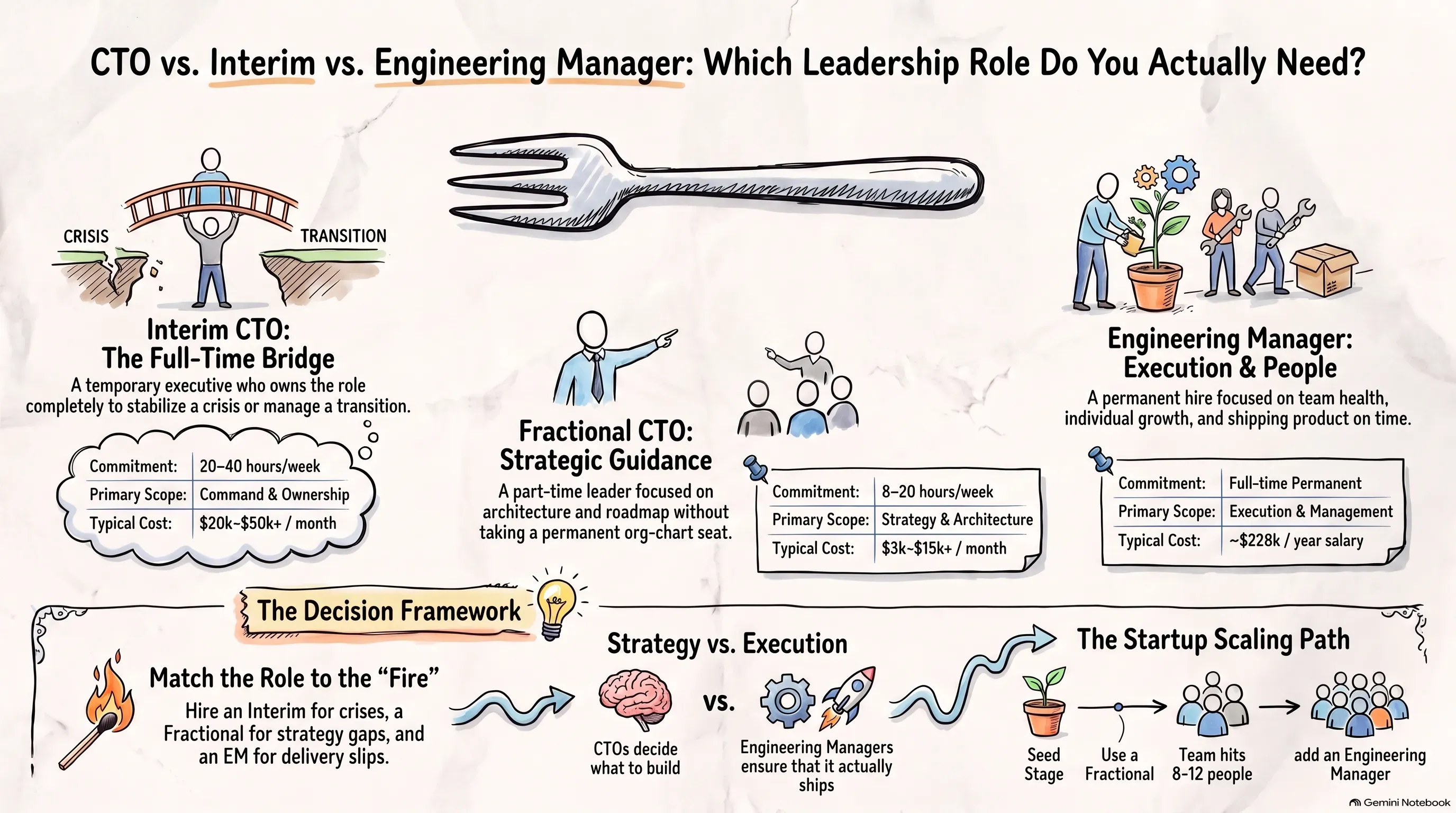
| Fractional CTO | Interim CTO | Engineering manager | |
|---|---|---|---|
| Engagement model | Ongoing part-time, no org-chart seat; delivers an outcome | Full-time temporary; owns the role with a planned end date | Permanent full-time hire under existing direction |
| Typical duration | 6–18 months, renewable | 3–9 months, 3–6 most common | Permanent |
| Hours/week | ~8–20, one to two days a week | 20–40 | Full-time |
| Cost model | Retainer, $3–15k+/month | Day rate; $20–50k/month | Salary, ~$228k/year average |
| Seniority & scope | Strategy: architecture, roadmap, first hires | Strategy plus command: team, board, delivery | Execution plus people management |
| Time to start | 1–2 weeks | Days | 4–6 month search for the CTO-level equivalent |
| Equity | Rarely; 0.5–2% when used | None | Standard; 0.5–2% is the CTO-level norm |
One caution on reading it: the cost row is a month of spend, not a like-for-like price. A $25k interim month, a $10k fractional month, and a $19k engineering-manager month buy three different things. The interim premium buys urgency and full ownership. The fractional retainer buys senior judgment at part-time volume. The EM salary buys a permanent internal capability.
These aren't three seniority tiers of one job. They're three different answers to three different situations.
What each option costs
The interim CTO day rate is the unit that matters, so start there. A US interim CTO typically runs $200–400 per hour or $25,000–$50,000+ per month onshore. Offshore engagements run $5,000–$10,000 monthly, which explains the low end of most broad pricing bands. In the UK, day rates run £800–£1,000 for solid operators, £1,000–£1,300 for senior, and £1,300–£1,500+ for elite, which works out to £17,600–£33,000+ a month over 22 working days, with agency sourcing adding 15–25% in fees. Annualized compensation ranges from $259,000–$489,000 with a median of $366,000. No equity. An interim can start within days, versus a 4–6 month search for a permanent CTO.
Fractional CTO cost runs lower because you're buying senior judgment at part-time volume, not a full-time seat. Typical figures: $150–$500 per hour, $3,000–$15,000+ per month on retainer, or $50,000–$150,000 per year, roughly 60–70% less than a fully loaded full-time CTO. Fractional CTO rates translate to a day rate of $1,200–$5,000. The retainer scales with intensity: roughly $8,000–$12,000 a month buys about one day a week, around $15,000 buys two, and $25,000+ buys three or more. Equity of 0.5–2% shows up in some fractional deals, often with reduced cash.
An engineering manager is a salary, not a fee. Average US total pay is $227,605, with the middle 50% between $183,702 and $286,578. Big Tech medians skew high. The closest official proxy, BLS's architectural and engineering managers, shows a median of $171,270 as of May 2025. Add benefits, payroll, and a permanent seat.
For contrast, the reason all three alternatives exist: a full-time CTO is a $250,000–$500,000 total-compensation hire, or $300,000–$500,000+ fully loaded. Fractional CTO services offer strategic leadership at a fraction of full-time cost.
Monthly cost is the wrong comparison if it ignores what you're buying: a bridge, an outcome, or a permanent capability.
Engineering manager vs CTO: strategy, execution, and people management
The cleanest one-line axis: a CTO decides what to build and why; a head of engineering makes sure it actually ships. The CTO's horizon is years. Engineering management runs from this sprint to this quarter.
Orientation follows scope. A CTO is primarily externally oriented, owning technical vision and architecture and representing technology to investors, customers, and the board, while a VP of Engineering is primarily internally oriented, owning team structure, planning, hiring and development, and whether the roadmap ships on time and at quality. That's the real content of the vp of engineering vs cto question, and the hierarchy settles the rest: engineering manager at the bottom with 6–12 reports, sometimes a Director in between, then VP of Engineering leading multiple teams, then the CTO. Titles are used loosely across companies; treat "head of engineering" as a label whose meaning depends on the org chart holding it, and test the actual scope of any role against the axis above rather than its name.
Scale decides when one person can't do it all. At 10 engineers one person usually does both the CTO and VPE jobs; at 50 the roles start to separate; at 150, running them as one job is a significant organizational risk. Under 15 engineers, one person doing both strategy and team management works fine, and somewhere around 15 to 20 the seams show, with team management usually what gets dropped. A full-time CTO starts to make sense at roughly 8–12 engineers. Most startups under 20 engineers need neither an interim nor an outsourced CTO; a fractional or a coach is the starting point.
The same logic answers the "head of engineering vs cto" question in hiring terms: hiring a CTO when you need a VP of Engineering, or the reverse, produces different problems, and both are expensive.
Where does that leave interim and fractional? Both are executive-grade, and the difference between them is not rank. An interim sits in the org chart with an end date and full accountability; a fractional delivers outcomes part-time without a seat. Same seniority, different commitment, different exposure.
Hire for the function you're missing: strategy, execution, or people. Not for the title.
When to hire a CTO, and when to hire the other two instead
The whole decision collapses into one question: does engineering have an owner today? Run the fork in this order.
Question 1: Is the seat empty, and is it urgent? CTO quit, team in crisis, M&A in flight, a scaling emergency. Is your house on fire? Pay the premium, get it stabilized with an interim CTO, then figure out the long term. The interim can be running things in days while a permanent search takes 4–6 months.
Question 2: Is the team working but strategy-light? Developers in place, delivery happening, but no architecture, no roadmap, no technical story for the fundraise deck. That's a fractional CTO. At seed there is often only 10–15 hours a week of real CTO work to do.
Question 3: Is direction set but execution weak? Missed sprints, attrition, quality problems, people issues nobody has time for. That's an engineering manager.
One test separates all of these from the cheaper option you might be tempted by: a consultant recommends; a fractional or interim CTO owns. If delivery slips, are they answerable to you and the board?
Stage by stage: pre-seed, a CTO coach for the technical founder; seed, a fractional CTO one day a week for architecture and first hires; Series A/B, the fractional either goes full-time or you hire a permanent CTO and the fractional moves to advisor. The sequences chain together well: a common pattern is interim coverage for one to two quarters to stabilize, a step down to fractional once the team is functioning, then a handoff to a permanent hire. When delivery and team structure need dedicated attention so the CTO can focus on architecture and external relationships, the first deliberate leadership hire is typically a VP of Engineering.
If you're a non-technical founder with no senior engineer, the strategic gap is your biggest risk and the CTO-shaped role comes first, because a team manager cannot fill the vacuum of nobody being able to evaluate architecture or interview engineers. So if you're running a "CTO for startup" search from this position, budget for a fractional retainer, not a full-time seat. How to hire a CTO becomes critical at this stage.
Budget sets a floor, in UK terms: £2,000–£5,000 a month maps to a fractional CTO one to two days a week, £12,500+ a month makes full-time viable if the role is justified, and an emergency at any budget maps to an interim at day rates.
If you've read this far and the answer still isn't obvious, it's usually fractional: most startups under 20 engineers over-hire urgency.
The cost of choosing wrong
Every one of these mis-hires has a price, and most of them are quiet until the bill arrives.
Fractional into a vacuum. A team with no owner needs daily command. Ten hours a week of excellent judgment can't stop daily drift, so you pay fractional rates and still lose the quarter.
Interim for a fractional-sized problem. Paying £1,200 a day for a situation that only needs two days a week of attention is a named failure mode. Hiring interim too early wastes months and budget and frustrates the team, and short-term interim fixes can create problems two years later.
Promoting your best engineer. Your strongest IC becomes an unhappy, undertrained executive, and you lose your best builder in the same move. That moment is what hiring a trained engineering manager is for.
Hiring a team-builder when the gap was direction. The team hums along building something nobody needed, and you don't find out for months.
Rushing the permanent CTO. A panicked six-week CTO hire fails at the worst possible moment, about nine months in, after re-architecting around their instincts. Recruiting fees run 20–30% of salary, and correcting a bad hire costs 2× salary, with US search fees at 25–35% of first-year comp.
Over-hiring seniority early. Paying for capacity you don't use, giving away equity for a role that doesn't exist yet, and an overqualified hire who gets bored and starts improving things that don't need improvement. The "we need a CTO" panic usually masks a more specific problem that doesn't require a $300k+ hire.
The cheapest role on this list is the one that matches the gap. The most expensive is the almost-right one.
You've picked the role, now evaluate the person
To hire an interim CTO (or a fractional one, or an EM) well, run this funnel. It's written from the interim angle because that's the tightest timeline, but the machinery works for all three.
1. Write the mandate before you look at anyone. Define success for days 30, 60, and 90. Know which operator you need: turnaround, due diligence, or a people-first stabilizer. A worked example of a mandate brief: within 90 days, perform a full technology audit, introduce agile sprint practices, and prepare a roadmap for migrating infrastructure to Kubernetes. Set decision rights explicitly, because interim leaders fail when they're expected to own outcomes without clear authority.
2. Source where these people actually are. Traditional job boards rarely suffice; interim CTOs move through niche professional networks, specialist interim CTO services firms that can deploy vetted candidates within days, and investor and advisor lists. Your own network first, and ask other founders; the best fractional and interim operators rarely need to advertise.
3. Interview as operating conversations, not biography reviews. Present your real problem and ask how they'd structure month one, what they'd assess first, how they'd establish authority, and how they'd report progress. Structure: a 30-minute screen, a 60–90-minute deep dive, references, and an optional take-home, about 3–4 hours per candidate over one to two weeks. Interview 3–4 candidates to calibrate. Evaluating CTO candidates with this structured approach works for permanent hires too.
4. Score answers against STAR-T: situation, task, action in the first person, measurable result, takeaway.
5. Run a bounded paid mini-challenge. Two to four hours: an architecture review, a scenario response, a board-presentation draft. It reveals thinking without turning into free consulting.
6. Check references harder than you would for a permanent hire. They matter even more in interim hiring than in permanent search. Contact 2–3 founders from recent engagements and ask what outcomes they delivered, whether they were available in urgent situations, what type of company or situation they would NOT be a good fit for, and whether they'd hire them again.
7. Trial, then commit. A paid 2–4 week trial with a bounded deliverable before an ongoing engagement, then a 3-month check-in; decision to start runs 4–8 weeks total.
8. Nail the contract. The company owns all code and deliverables, with handover materials (architecture diagrams, credentials, process guides, pending tasks) delivered before final payment. Cover NDA and confidentiality, IP ownership, milestones, a termination clause, and duration terms. Track KPIs like sprint completion rate, uptime, deployment frequency, technical-debt reduction, and time to market. Negotiate on commitment or duration, not day rate, because asking for a 20% discount signals you don't value their time.
Red flags that justify walking away: no verifiable CTO-title accountability with real budget, board, and hiring authority; can't articulate failures; prescribes before diagnosing; won't provide references; dismissive of your team; more interested in the technology than the business. Also beware overpromised availability from someone serving four or five other clients, and don't hire for prestige instead of fit, the most common interim-hiring mistake.
What working looks like in week one: the right interim creates visible clarity early. Priorities sharpen. Delivery conversations become more grounded.